At the department of Mathematics, we offer several specialised Master’s degree programmes in both classical theoretical mathematics and broader associated subjects. All our MScs are two years in duration, and all the programmes are flexible, allowing you to specialise in your academic interests early on. Furthermore, our programmes are taught by active researchers, which ensures high-quality, up-to-date education.
As the study programmes have relatively small classes, students can form close relationships with their peers and teachers and gain excellent opportunities to become associated with research groups while studying. We pride ourselves on being a diverse department. Our researchers come from all over the globe, which also creates a great international study environment.
The Mathematics department is located in the heart of the Uniparken campus, which has been voted one of the most beautiful campuses in the world. This gives close access to the Royal Library and other facilities on campus, all while being just a 15 minute walk from the city centre!

The Master’s degree programme in Data Science focuses on both general and specialist competences. You will acquire general competencies through three compulsory courses covering advanced statistical learning, large scale optimization and data visualisation. You will develop specialist competences through a 30 ECTS specialisation package, and you can choose between the following four packages: Computational Statistics, Data-Intensive Systems, Finance and FinTech and Signal Processing.
The programme is taught in English, and large parts of it can be designed to match your specific academic interests, through elective elements and through your choice of specialisation package.

Mathematics is part of everyday situations such as using your debit card, navigating by GPS, making calculations in physics or chemistry, or working out the pot odds in the midst of an important hand of poker.
The two-year MSc programme in Mathematics at Aarhus University targets students from tertiary education institutions in Denmark and abroad. The degree programme is flexible and shaped to match the academic interests of the individual student, allowing you to specialise in a particular subject area within mathematics while at the same time acquiring general competencies in mathematics.
The teaching at the university is greatly influenced by the research conducted here, as the lecturers are active researchers. The Master’s thesis written during the final year of the degree programme carries considerable weight and, in this context, students benefit from the informal atmosphere between staff and students.
When writing your thesis, you will have excellent opportunities for becoming associated with a group of researchers. In this way, students also participate in the group’s research projects and scientific discussions. They can specialise in a topic within a broad area, including one of the three areas of mathematics in which Aarhus University is particularly strong:
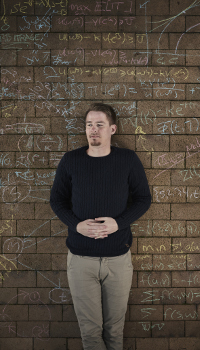
Have you thought about how you fix the rate of a new mortgage loan with an interest rate ceiling, or the popular interest-only types of loans? In fact, Mathematics-Economics graduates developed the model used to fix the cost of such loans. Every major company is regularly faced by complex problems, and many contact a mathematics-economist when this happens. Mathematics-economists are experts in designing optimisation strategies, which requires great theoretical insight into both economics and mathematics.
As a student of mathematics-economics, you have the option of specialising in a topic within a broad area, including one of the areas of mathematics-economics in which Aarhus University is particularly strong:

What should your home contents insurance cost? How many people will survive a certain disease? What are the odds of winning a game of solitaire? The two-year Msc programme in Statistics at Aarhus University targets students from tertiary education institutions in Denmark and abroad. The degree programme is also flexible, which allows students to specialise while at the same time acquiring general competencies in statistics. As a student of statistics, you have the opportunity to specialise in a topic within a broad area, including one of the areas of statistics in which Aarhus University is particularly strong:
The teaching at the university is greatly influenced by the research conducted here, as the lecturers are active researchers. As an MSc student, you will benefit from the down-to-earth, informal atmosphere between staff and students, particularly when writing your thesis, which carries considerable weight in the final year of the programme.

The Master's degree program in Science Communication (aka. SciComm) is a research-based program built on a foundation in natural sciences, providing advanced competencies in the analysis, planning, and execution of communication within science and technology.
The program is both theoretical and practice-oriented. As a student, you will get hands-on experience testing various methods within science communication. Assessments will primarily be portfolio-based, and special emphasis is placed on making the 15 ECTS final thesis part of a collaboration with an external partner (for example, a company or institution).
The Master's degree program in Applied Data Analytics is a research-based program focusing on the application of modern data analytical and data science methods to scientific problems. The programme is designed for students with a natural sciences background who want to develop advanced competencies in data analysis within a specific scientific domain.
The program combines methodological training in data science with applications in real-world scientific contexts. Students learn how to work with the entire data analysis pipeline, from data collection and cleaning to visualization, modelling, interpretation, and communication of results. The final 15 ECTS master's thesis is typically embedded in a research project and carried out in collaboration with a scientific research group or, in some cases, an external company.
– the portals address students already enrolled