
Two researchers receives grants from Independent Research Fund Denmark (DFF)
Cristiano Spotti and Jan Frahm, both from the Department of Mathematics, each receive a grant from Independent Research Fund Denmark (DFF)
Cristiano Spotti – The multiscale geometry of hyperkähler spaces
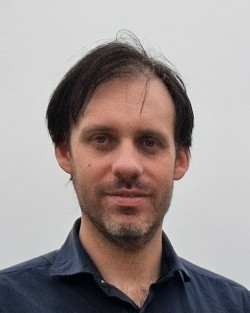
Hyperkähler spaces are remarkable geometric structures that arise naturally in modern mathematics and theoretical physics. A major challenge is that these spaces often develop singularities or occur in families whose geometry changes dramatically under degeneration. Rather than viewing these singularities as pathological phenomena, recent developments suggest that they contain rich geometric information that can be uncovered by studying the space at different scales. By ‘zooming in’ on singular regions, interesting geometric models are expected to emerge, much as microscopes reveal hidden structures in physical materials.
The project aims to develop new mathematical tools to describe these multiscale phenomena in hyperkähler geometry. Particular emphasis will be placed on understanding the local geometric models that arise near singularities and relating them to algebraic structures. In addition to advancing our understanding of hyperkähler spaces, the project is expected to contribute to broader questions concerning singular geometric spaces, moduli spaces and nonlinear geometric differential equations.
The project also includes the supervision of a PhD student and the organisation of scientific activities, including seminars, international research visits and a workshop at Aarhus University. Through these activities, it will help strengthen geometry research in Denmark and support the training of early-career researchers in this area of mathematics.
Congratulations to Cristiano on the grant!
Links
Jan Frahm – Exceptional Theta Correspondences and Applications

Symmetry plays a central role in mathematics, helping us understand complex objects by revealing which properties remain unchanged under transformations. In his project, Jan explores the theta correspondence, a subtle principle that connects two seemingly different forms of symmetry. While this idea has led to major breakthroughs in number theory, classical theory excludes exceptional groups – highly structured symmetry objects that remain difficult to study.
Building on his recent groundbreaking work, Jan develops new analytical methods to make these symmetries accessible and computable. The project establishes a unified framework for studying entire families of exceptional groups and applies the resulting correspondences to the construction of automorphic forms, which play an important role in number theory. Through advanced analysis, international collaboration and the training of a postdoctoral researcher, the project aims to advance the understanding of symmetry across several areas of mathematics.
“What makes this project particularly exciting for me is its possible connection to analytic number theory through the lifting of automorphic forms, which are objects encoding deep arithmetic information.”
– Jan Frahm
Congratulations to Jan on the grant!